
Ola Electric Share Price Gain: A Sign of Market Confidence

Ola Electric Share Price Gain

Ola Electric, one of India’s most talked-about startups in the EV (electric vehicle) space, is once again at the center of attention on Ola Electric Share Price Gain —but this time, not because of new scooter models or IPO ambitions.

Instead, it’s the company’s stock price that’s making headlines, following a strong rally on the Indian stock exchanges. In recent trading sessions, Ola Electric’s shares surged by double digits, drawing eyes from investors, analysts, and industry observers alike.

What makes this surge particularly interesting is the timing. The stock’s rally comes amid a complex period for the EV sector and the company itself—Ola Electric recently reported its quarterly financials, and the numbers were not traditionally considered “bullish.”

Losses widened year-on-year, revenue dropped compared to the same period in the previous fiscal, and the industry as a whole continues to battle subsidy rollbacks, supply chain issues, and intense competition. Yet, the share price gained ground—suggesting the market is seeing something beyond the immediate data.


The Post-IPO Journey

Ola Electric’s stock market debut in 2024 was one of the most anticipated IPOs in recent memory. As the country’s leading electric two-wheeler manufacturer, the company was seen as a proxy for India’s EV future. Investors lined up to bet on what many described as the “Tesla of India.”

However, the stock has had a rocky journey since listing. After the initial euphoria, the share price corrected significantly, as concerns around high cash burn, delayed profitability, and execution risks came to the surface that Ola Electric Share Price Gain.

But like many new-age tech and mobility companies, Ola Electric is not being judged solely by its earnings—at least not yet. Instead, investors seem focused on trajectory, strategic direction, and the company’s ability to stay ahead in a market that is both promising and punishing.


A New Narrative for Ola Electric Share Price Gain

image 5

The recent rally in Ola Electric shares seems to signal a new narrative taking hold among market participants. Instead of being weighed down by quarter-to-quarter losses, investors are increasingly willing to look at the big picture.

Ola Electric operates in a sector undergoing rapid transformation. With state and central governments pushing clean mobility, battery manufacturing, and charging infrastructure, the EV ecosystem in India is expected to witness explosive growth in the next five years.

Ola Electric is uniquely positioned in this space. It has a recognizable brand, a growing portfolio of products, and an aggressive approach to R&D and vertical integration.

Its Gigafactory project, plans for battery cell production, and aspirations for four-wheeler EVs give it a broader vision than most of its peers. While these projects are capital intensive, they also serve as a moat—especially if executed efficiently.


Investor Sentiment Turns Optimistic

Share price movements often reflect sentiment as much as fundamentals. And sentiment, by nature, is forward-looking. Market observers believe that investor mood around Ola Electric is improving, thanks to a combination of internal execution and external tailwinds.

While quarterly financials may not yet paint a rosy picture, subtle improvements in operating metrics, delivery numbers, and cost structures suggest that the company is moving in the right direction.

Importantly, the company’s management has begun to communicate more clearly. Updated forecasts, financial discipline, and transparent commentary during earnings calls seem to have reassured investors. Institutional interest has reportedly seen a slight uptick, and retail participation in the stock has remained stable despite earlier volatility.


An EV Sector Under Watch

The stock price movement also reflects broader market trends within the EV segment. Across the world, EV companies are seeing renewed attention.

Global giants like Tesla, BYD, and Rivian have experienced mixed market reactions over the past year, often driven by macroeconomic signals, battery technology advancements, and government policy changes. In India, the environment is no different.

The government’s commitment to EV penetration, though occasionally tempered by subsidy revisions, remains firm. Production Linked Incentives (PLI) schemes, FAME subsidies, and state-level benefits continue to support the EV industry. Moreover, rising fuel prices and increasing urban pollution are encouraging consumers to explore alternative transportation.

All of these macro-level indicators are creating fertile ground for long-term optimism in companies like Ola Electric. Investors appear to be factoring in the growth potential that comes with increased EV adoption, especially in a two-wheeler dominated market like India.


Balancing Optimism with Risk

image 6

Of course, share price gains do not eliminate the risks that lie ahead. Ola Electric remains in a capital-intensive business that requires continuous innovation and significant upfront investment.

The electric two-wheeler segment is becoming increasingly crowded, with players like Ather Energy, TVS, Bajaj, and Hero MotoCorp all jostling for market share. Additionally, consumer trust—linked to after-sales service, charging infrastructure, and product reliability—will be crucial in determining who leads in the long run.

Then there’s the international angle. As Ola eyes exports and global expansion, it will face an entirely new set of competitive and regulatory challenges. Breaking into markets beyond India will demand not just good products but localized strategies, distribution networks, and regulatory compliance—all of which require time and money.

Yet, the recent upward movement in its stock suggests that investors, for now, are choosing to believe in the company’s ability to navigate these complexities.


Where Do We Go From Here?

With the Ola Electric Share Price Gain momentum, questions naturally arise: Is this the beginning of a sustainable rally? Or is it a temporary bump fueled by sentiment?

The answer likely lies in the next two to three quarters. If Ola Electric can continue to demonstrate operational improvement, reduce cash burn, and deliver on volume and margin targets, the stock could continue to build upward momentum.

Additionally, if macroeconomic conditions stay stable and EV policies remain supportive, it could create a tailwind not just for Ola but for the entire sector.

As Ola Electric Share Price Gain for now, Ola Electric’s stock is sending a message—it is not being written off. The market is watching, and more importantly, the market is hoping. And in stock markets, hope backed by progress can be a powerful driver.


Conclusion

The recent rise in Ola Electric Share Price Gain is more than a number—it is a reflection of changing investor mood and renewed belief in India’s EV future. While challenges abound, the company has shown enough signs of progress to rekindle interest among retail and institutional players alike.

In a market that is quick to reward growth and punish stagnation, Ola Electric’s rally could be a case of early believers placing their bets again. The company’s next steps—both in product innovation and financial execution—will determine whether this price action is a short-lived bounce or the beginning of a meaningful turnaround.

Only time will tell. But for now, Ola Electric is back on the radar—and riding a wave of cautious optimism.


Wimbledon & India vs England Test Series Drama: A Sporting Double Delight

India vs England Test Series

In the world of sports, few periods bring such concentrated drama as the early weeks of July. This year, that window offered fans a rare double treat — the elegance and intensity of Wimbledon 2025, and the adrenaline-fueled rollercoaster of the India vs England Test series.

Both events, though vastly different in nature and tradition, captured global attention with their own brand of storytelling, brilliance, and controversy.


🎾 Wimbledon 2025: Tradition Meets Transformation

Held at the iconic All England Club in London, Wimbledon 2025 was a spectacle of poise, precision, and progress. This year’s tournament marked a turning point in its long-standing traditions. For the first time in history, electronic line calling fully replaced human line umpires, signaling tennis’s embrace of technology while retaining its graceful, white-clad aesthetics.

Sinner’s Statement Victory

The men’s singles final became an instant classic, pitting Italian sensation Jannik Sinner against Spain’s flamboyant Carlos Alcaraz.

With both men having already carved reputations as future legends, their clash was expected to be tight — and it delivered. Alcaraz struck early, taking the first set with explosive pace. But Sinner’s poise under pressure and his laser-focused baseline game turned the tide.

Sinner rallied back to win the next three sets, showcasing not just skill but maturity. His down-the-line backhands and razor-sharp return game left Alcaraz struggling for rhythm. With this victory, Sinner not only claimed his first Wimbledon title but also became the first Italian man to lift the trophy at SW19 — a monumental achievement for both the player and his country.

Świątek’s Supreme Dominance

On the women’s side, Iga Świątek stunned the tennis world with a truly historic performance. In the final, she dispatched her opponent with a double bagel score of 6-0, 6-0 — a rare and ruthless feat at any level, let alone a Grand Slam final. Her footwork, depth of shot, and mental clarity left little doubt that she remains the most dominant woman in tennis today.

Celebrities, Royals, and Style

As always, Wimbledon was not just a tennis tournament — it was a cultural event. Royalty and celebrities filled the stands. From movie stars to former champions, all dressed in fine English summer fashion, the event maintained its reputation as the most elegant sporting competition in the world.

While the play on court was fierce, the atmosphere remained steeped in class, ceremony, and the timeless crack of a ball on grass. Wimbledon 2025 blended modernization with age-old tradition — proving that the game can evolve while still honoring its past.


🏏 India vs England Test Series: When Cricket Turned into Combat

image 3

If Wimbledon showcased the calm and classy side of sport, the India vs England Test series was pure, high-octane drama. Played across England in historic stadiums like Headingley, Edgbaston, and Lord’s, the five-match series had everything — masterful batting, lethal bowling, crowd eruptions, and even on-field confrontations that echoed the fierce rivalries of yesteryear.

Test 1: Thrills at Headingley

The series opener set the tone for what was to come. India posted imposing totals in both innings, thanks to centuries from Yashasvi Jaiswal, Shubman Gill, and KL Rahul. Rishabh Pant, returning from injury, became the first Indian wicketkeeper to score hundreds in both innings on English soil.

Yet, in a stunning turn of events, England chased down a mammoth 371-run target in the fourth innings. Ben Duckett’s blistering century and Joe Root’s calm anchoring saw the home side seal a five-wicket win. It was a masterclass in fourth-innings aggression and marked the return of England’s high-risk “Bazball” approach.

Test 2: India’s Answer in Birmingham

India bounced back hard in the second Test. Led by captain Shubman Gill, who played one of the finest matches of his young career, India crushed England by over 300 runs. Gill scored a double century in the first innings and followed it up with another 150-plus score in the second — the highest combined total by an Indian captain in a single Test.

The bowling attack was equally fierce. Mohammed Siraj’s consistency and Akashdeep’s devastating pace dismantled the English batting line-up. India’s win at Edgbaston was historic, being their first at the venue in nearly four decades. The India vs England Test Series was now level, and tensions were rising.

Test 3: Lord’s Turns Hostile

The third Test, played at the prestigious Lord’s Cricket Ground, saw the emergence of a different kind of cricket — not just tactical but emotional, even confrontational. With the series finely poised, the players from both sides turned up the heat.

Shubman Gill and England opener Zak Crawley were involved in a verbal spat that grew increasingly intense as the day wore on. Sledging, long stares, and sarcastic applauses peppered the day’s play. England bowler Jofra Archer unleashed a barrage of bouncers, while Ben Stokes led from the front with both bat and mouth.

India fought hard, but England’s bowlers managed to pull off a tight win by 22 runs. The match, dubbed by fans as “Bazbrawl” rather than Bazball, signaled that the friendly image of English cricket was giving way to an aggressive, win-at-all-costs mentality.


🎯 Key Themes and Contrasts

While both Wimbledon and the India vs England Test Series occurred in the same region and timeframe, they couldn’t have been more different in tone. Yet, both told compelling stories about sport’s evolution, the human spirit, and the weight of legacy.

ThemeWimbledon 2025India vs England Test Series
Tradition vs. InnovationIntroduction of electronic line callingEngland’s Bazball clashing with Test orthodoxy
Emotional IntensityQuiet tension, composed brillianceVerbal clashes, raw emotion, national pride
Star PerformancesSinner’s maiden win, Świątek’s dominanceGill’s records, Duckett’s fearless chasing
Cultural ImpactTennis blended with fashion and royaltyCricket fused with nationalism and intensity
Narrative ArcClear-cut champions crownedMomentum swinging wildly between both teams

🏆 Why These Events Matter

Wimbledon reaffirmed its status as the most dignified and progressive tennis tournament. It embraced technological change without sacrificing charm, and in doing so, laid a roadmap for the future of tennis. Players like Jannik Sinner and Iga Świątek are not just winners — they are the new standard bearers of discipline and class.

The India vs England Test Series, meanwhile, breathed new life into Test cricket. In an era where shorter formats dominate, these matches reminded fans why the red-ball game still captivates. The high scores, dramatic collapses, record chases, and personal confrontations showed that Test cricket is not just surviving — it is thriving.


Conclusion

Whether it was the neatly-trimmed lawns of Wimbledon or the lush green pitches of Lord’s, England in July 2025 became the center of the sporting universe. Fans were treated to both ends of the emotional spectrum — from elegant forehands to fiery bouncers, from standing ovations to heated stare-downs.

What unified these events was passion. The passion to win. The passion to honor history. The passion to write a new chapter.

As we reflect on this sporting doubleheader, one thing is clear: sport, in all its forms, remains a mirror of human aspiration — unpredictable, emotional, and unforgettable.

Should PM Modi Speak Hindi or Marathi in Rajya Sabha?

pm modi

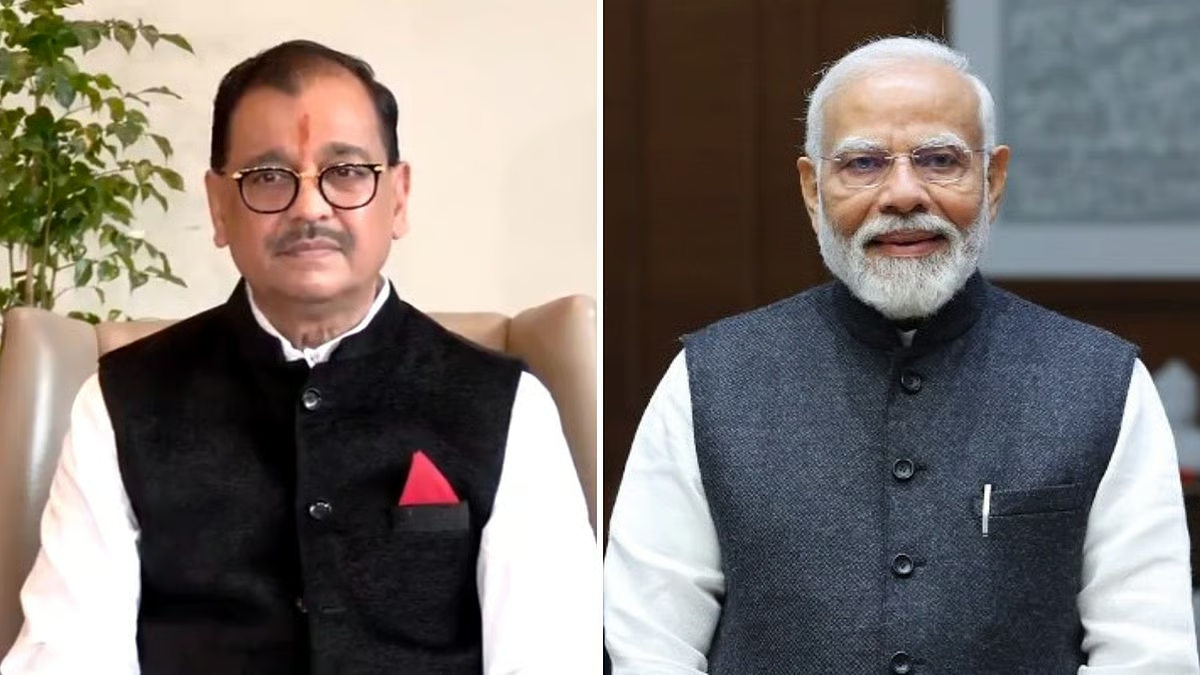
In July 2025, when Ujjwal Nikam — a renowned lawyer known for leading the prosecution in the 26/11 Mumbai attacks — received a phone call from PM Modi, the exchange was meant to be ceremonial. But what stood out was Modi’s opening line: “Ujjwal ji, mi Marathit bolu ka Hindit bolu?” (Should I speak in Marathi or Hindi?).

While this might seem like a playful, respectful gesture, it stirred up a deeper debate on language politics in India — particularly, should the Prime Minister speak Marathi in the Rajya Sabha when addressing or engaging with members from Maharashtra?

If you are more curious about the Income Tax Return Filing Start Date, then you can read our article and get more info on it.


1. Why Does Language Choice in Parliament Matter?

Constitutional Framework

India’s Constitution allows parliamentary debates in Hindi or English. However, members can use other scheduled languages if permitted by the Chair, provided translation support is available. This ensures accessibility and understanding across a linguistically diverse audience.

Cultural Significance

In a country where language is deeply tied to regional identity, such gestures take on political and emotional weight. Maharashtra has a long history of language-based identity movements. For many in the state, hearing Marathi in national forums like the Rajya Sabha feels like recognition of their heritage.


2. The Case for Hindi: The National Context

Wider Reach

Hindi is the most widely spoken language in India. As Prime Minister, PM Modi speaking in Hindi ensures that his message is understood by the majority of the nation. For Parliament, where clarity, reach, and uniform understanding are essential, Hindi serves as a common medium.

Parliamentary Convention

Traditionally, speeches in Rajya Sabha are delivered in Hindi or English. It maintains consistency, formality, and efficiency in parliamentary discourse. A shift from this could potentially lead to confusion unless translation systems are perfectly streamlined.


3. The Case for Marathi: Symbolism and Connection

1000040038

Emotional Resonance

Speaking in Marathi, even briefly, is a powerful symbol of inclusion. It can make Marathi-speaking citizens feel acknowledged at the national level. For a leader, even a few words in a regional language can have a significant emotional impact.

Political Outreach

Maharashtra is a politically important state. Regional pride runs high, especially when it comes to language and culture. When the Prime Minister uses Marathi, it sends a message that the central government respects regional identities — something that could translate into electoral goodwill.


4. Risks and Challenges

Tokenism

A major risk is that such gestures could be seen as symbolic without substance — a form of political pandering. If not followed by real policy engagement or consistent cultural respect, it might be dismissed as hollow showmanship.

Precedent Concerns

If the Prime Minister starts speaking Marathi in the Rajya Sabha, will there be expectations to speak in Tamil while addressing Tamil Nadu, or in Bengali for West Bengal? While multilingualism is part of India’s DNA, operational challenges in a national forum like Parliament must be considered.


5. Reactions on PM Modi: Public and Political Perspectives

Appreciation and Criticism

Many Maharashtrians have expressed appreciation for PM Modi’s use of Marathi. It is seen as a respectful gesture. However, there are also those who feel that such acts should be backed by policy-level support for regional languages in education and governance.

Language Politics in Maharashtra

Language has long been a sensitive issue in Maharashtra. Political parties have campaigned on protecting Marathi language and culture, and tensions have often arisen over the prominence of Hindi or English in public life. In this context, the Prime Minister’s choice of language is carefully scrutinized.


6. Deeper Implications: More Than Just a Language Choice

Encouraging Linguistic Diversity

If leaders occasionally use regional languages in national spaces, it sets an example of inclusivity. It encourages younger generations to take pride in their mother tongue and promotes the idea that India’s unity lies in its diversity.

Strengthening National Integration

Rather than dividing, respectful use of regional languages by national leaders can foster stronger integration. It signals that every state, every culture, and every language has a voice and a place in the Indian Union.


7. Finding a Balanced Approach

Hybrid Speeches

One possible solution is for leaders like the Prime Minister to begin their speeches with a few lines in the regional language — as a gesture of respect — and then continue in Hindi or English. This hybrid approach can strike the right balance between symbolism and functionality.

Consistency in Messaging

While using Marathi is culturally significant, the core content should remain in a language that is understood by the majority of Parliament members and the country. This ensures that messaging remains coherent and consistent.


Conclusion

The question of whether PM Modi should speak Hindi or Marathi in Rajya Sabha touches on deeper themes — identity, inclusion, unity, and communication. In truth, both languages serve important purposes.

Speaking Marathi, even briefly, can be a powerful way to connect with the people of Maharashtra, showing that their language is valued at the highest levels of government. At the same time, Hindi remains a practical and widely understood language for conducting national discourse in Parliament.

Ultimately, a Prime Minister must be a communicator for the entire nation. By weaving regional respect with national responsibility, PM Modi — and other leaders — can build bridges through language, fostering a more inclusive and unified India.

Income Tax Return Filing Start Date for FY 2024–25 (AY 2025–26): What Taxpayers Need to Know

income tax return

The Income Tax Return (ITR) filing season is one of the most crucial times of the year for individuals, businesses, and professionals in India. For the Financial Year (FY) 2024–25 and Assessment Year (AY) 2025–26, the process officially begins on April 1, 2025, as per usual practice.

With every passing year, compliance rules tighten, systems become more digitized, and expectations from taxpayers increase.

This article provides a complete guide on the start date of ITR filing, who needs to file, the due dates, document checklist, common mistakes, and the importance of filing early.


What Are Financial Year and Assessment Year?

Before diving into dates and procedures, let’s clarify these two key terms:

  • Financial Year (FY): The year in which income is earned. For example, FY 2024–25 is the period from April 1, 2024, to March 31, 2025.
  • Assessment Year (AY): The year following the financial year, when the earned income is assessed and taxed. For FY 2024–25, the AY is 2025–26.

Start Date for Filing ITR for FY 2024–25

income tax return

The Income Tax Department usually allows taxpayers to start filing returns from April 1 onward, but most online forms and utilities become available in May or June, depending on the ITR form type.

  • Official Filing Start: April 1, 2025
  • Utility Availability: ITR-1 and ITR-4 typically go live first; other forms (ITR-2, 3, 5, etc.) follow later.

Who Needs to File an ITR?

Filing income tax returns is mandatory if your income crosses the taxable limit. Here’s a simplified list of taxpayers who must file:

Individuals

  • Income exceeds ₹2.5 lakh (under 60 years)
  • Income exceeds ₹3 lakh (60–80 years)
  • Income exceeds ₹5 lakh (above 80 years)

Other Scenarios Requiring ITR Filing

  • You want to claim a refund
  • You have foreign income or assets
  • You are a company or firm, regardless of income
  • You have capital gains, even if not taxed (e.g., from equity)
  • You have TDS deducted and wish to report or claim refund

Types of ITR Forms

Choosing the correct form is essential for smooth filing. Here are the most common ones:

FormApplicable To
ITR-1Salaried individuals with income < ₹50 lakh
ITR-2Individuals with capital gains, foreign assets
ITR-3Professionals, business income
ITR-4Presumptive income scheme under Section 44AD/ADA

Key Due Dates for AY 2025–26

Knowing the filing deadlines helps avoid penalties and interest. Here are the important dates:

EventDue Date
Start of ITR filingApril 1, 2025
Last date (individuals)July 31, 2025
Last date with audit (businesses)October 31, 2025
Revised/Belated returnDecember 31, 2025

⚠️ Late filing beyond the deadline could attract a penalty up to ₹5,000 and interest under Section 234A, B, and C.


Why You Should File Early

Filing early has multiple benefits:

1. Faster Refunds

The sooner you file, the faster you’ll receive any refunds due.

2. Avoid Server Rush

Last-minute rush leads to technical glitches on the Income Tax portal.

3. Time for Corrections

Early filing gives you time to revise in case of any errors.

4. Loan & Visa Processing

Many institutions ask for ITRs when processing loans or visas. Filing early ensures timely documentation.


Documents You Need Before Filing

Here’s a checklist of essential documents:

  • Form 16 from employer (for salaried individuals)
  • Form 26AS and AIS/TIS (for tax credit details)
  • PAN & Aadhaar
  • Bank statements
  • Capital gains statements (for investors)
  • Interest certificates from banks
  • Details of foreign income/assets
  • Home loan certificate
  • Investment proofs for deductions (Section 80C, 80D, etc.)

Changes in ITR Filing for FY 2024–25

The Income Tax Department often brings minor changes in forms or rules each year. Expected updates for FY 2024–25 may include:

1. Pre-Filled ITRs

More robust pre-filled data, including income from mutual funds, dividends, rent, and interest.

2. AIS/TIS Integration

Taxpayers will be expected to reconcile their returns with Annual Information Statement (AIS) and Taxpayer Information Summary (TIS) to avoid mismatches.

3. Digital Verification

Emphasis on e-verification via Aadhaar OTP, Net Banking, or Digital Signature Certificates.


How to File Your ITR

There are several ways to file:

Online via Income Tax Portal

Through CA or Tax Expert

For business owners or individuals with complex incomes (capital gains, foreign assets), consulting a Chartered Accountant is advisable.

Offline Utilities

Download and fill Excel/Java utility offline and upload to the portal.


Common Mistakes to Avoid

  1. Using the Wrong ITR Form
    Leads to invalid return; may invite notices.
  2. Forgetting to E-Verify
    Return is considered incomplete if not verified within 30 days.
  3. Mismatch in Form 26AS & Return
    Can result in scrutiny notices.
  4. Claiming Incorrect Deductions
    Overstated deductions may lead to penalty.
  5. Missing Interest Income
    Many forget to include FD or savings interest.

Penalties for Late Filing

Filing your return after the deadline could lead to:

  • Late fee of ₹1,000 to ₹5,000 under Section 234F
  • Interest on outstanding tax under Sections 234A/B/C
  • Disqualification from future exemptions or loss of carry-forward of losses

Conclusion

Filing your Income Tax Return for FY 2024–25 (AY 2025–26) is not just a legal obligation but a smart financial habit. The process has become easier with digital advancements, but the importance of accuracy, timely submission, and proper documentation remains crucial.

Starting early allows you to avoid penalties, ensure refunds, and reduce stress during the peak deadline period. Whether you’re a salaried professional, freelancer, investor, or business owner, take charge of your tax filing today.

Remember, the taxman rewards discipline. Don’t wait—file smart, file early.